Place of Origin
Dongguan, Guangdong, China.
Material
Boron Nitride (BN).
Key Features
Electrical insulation, thermal shock resistance, self-lubricating properties, and easy machining. Our ceramic machining services support custom diameters, lengths, holes, and grooves according to your drawings.
Application Industries
Industrial furnaces, vacuum heat treatment, semiconductor manufacturing, glass processing, and aerospace. Applications include high-temperature vacuum insulation, molten metal sampling and stirring rods, plasma shielding, ion implantation components, glass-forming plungers, thermocouple protection cores, PVD/CVD deposition masks, and thermal insulation supports. Material suitability depends on the operating conditions.
Global OEM Supply
Serving OEM customers in the USA, Germany, Japan, and Europe. Custom boron nitride rods and components are available according to customer drawings and application requirements.
Delivery Time
Lead time depends on material availability, dimensions, machining requirements, and order quantity. Please send us your drawing for a quotation and estimated delivery schedule.
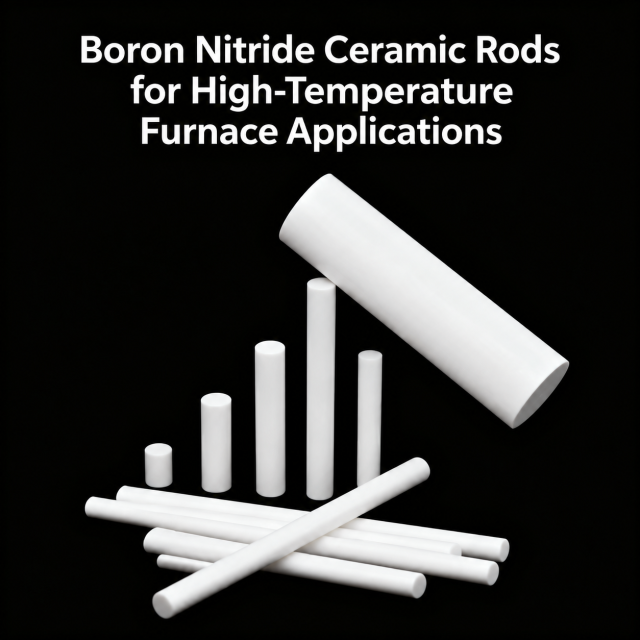
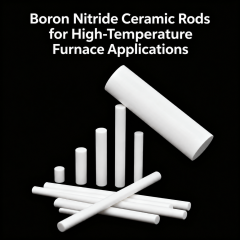
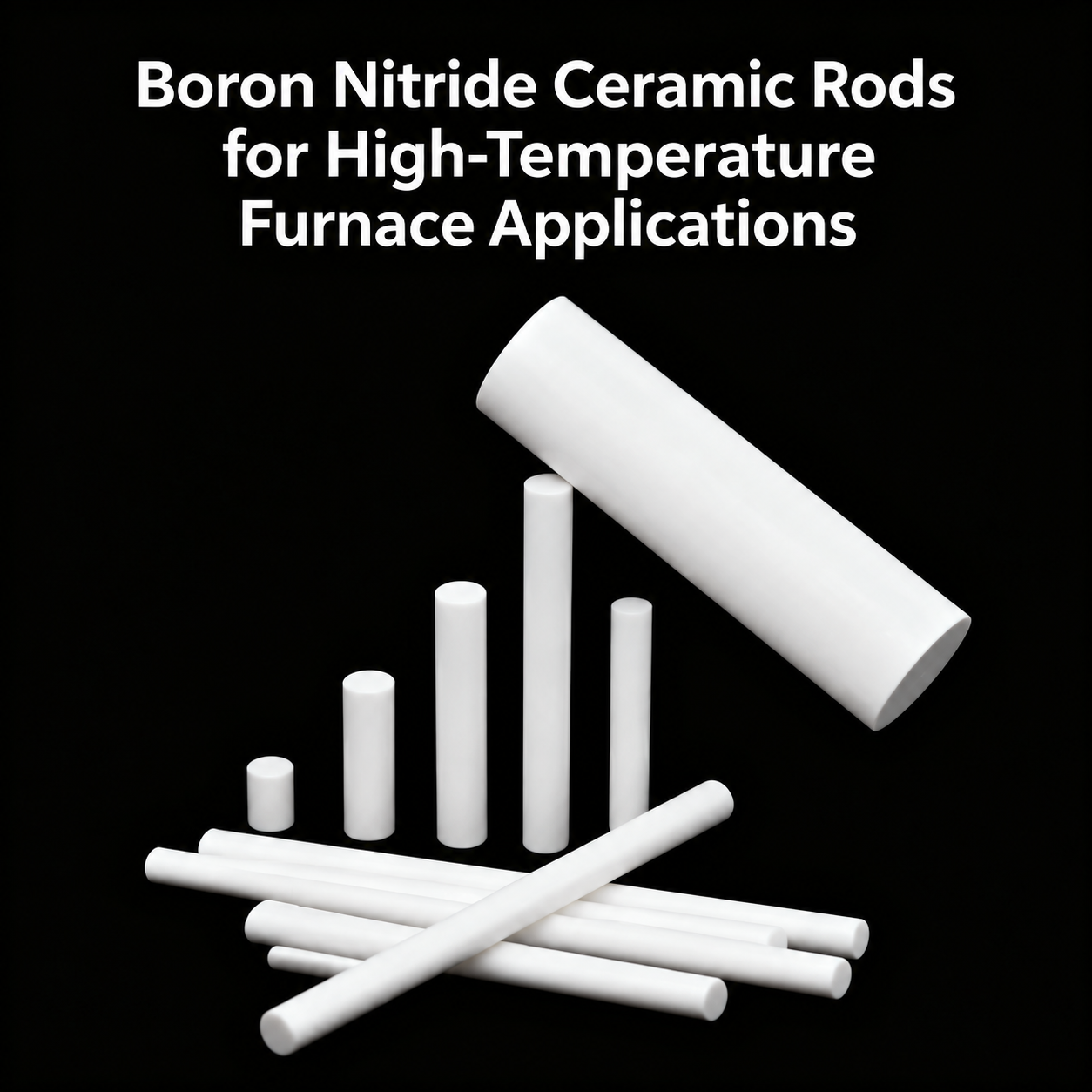
A boron nitride rod is a machinable ceramic component used for electrical insulation, spacing, and support in high-temperature furnaces, vacuum equipment, and laboratory heating systems. Made from boron nitride ceramic, it offers thermal shock resistance and low adhesion to selected molten materials. CERAMPRO supplies custom rods for assemblies that require electrical isolation, specific dimensions, or machined features that are difficult to produce in harder ceramics.
Material: Boron Nitride (BN)
The specified BN purity range is 99%–99.9%. Material selection depends on the operating atmosphere, contact materials, and cleanliness requirements.
For vacuum service, binder composition and moisture condition also matter. Please specify any restrictions on additives, contamination, or outgassing when requesting a material grade.
Plasma-facing and aerospace applications require a separate assessment of erosion, loading, and operating conditions.
Boron nitride machining allows rods to incorporate stepped diameters, axial holes, cross-holes, and grooves. This helps adapt the component to an existing assembly. Explore our ceramic machining capabilities.
BN can be considered for repeated heating and cooling cycles. Performance depends on the component’s shape, mounting arrangement, and rate of temperature change.
In compatible molten-material applications, its non-wetting surface can help reduce buildup and simplify removal after processing.
The material’s layered structure provides lubricity in suitable dry-contact conditions. Mechanical loads and wear requirements still need to be assessed.
| Parameter | Specified Value | Application Notes |
|---|---|---|
| Material Purity | 99%–99.9% BN | Confirm the required grade and allowable additives. |
| Thermal Shock Resistance | ΔT > 1500°C | Confirm the test method, specimen geometry, and cooling conditions. |
| Dielectric Strength | 40–100 kV/mm | Depends on grade, thickness, temperature, and test conditions. |
| Maximum Service Temperature | 900°C in air / 2000°C in inert atmosphere | Grade-dependent limits; continuous operation requires separate assessment. |
| Thermal Conductivity | 30–60 W/(m·K) | Depends on grade, temperature, and material orientation. |
| Machinability | Excellent | Suitable for turning, drilling, and milling with appropriate tooling. |
| Wetting Behavior | Non-wetting | Compatibility with molten aluminum, magnesium, zinc, or glass requires process-specific confirmation. |
These reference specifications must be confirmed against the selected material grade. They do not represent guaranteed performance under every operating condition.
| Material | When to Consider It | Main Selection Consideration |
|---|---|---|
| Boron Nitride | Machinable ceramic insulation and compatible molten-material contact. | Check mechanical loading, atmosphere, and grade composition. |
| Alumina | Rigid insulating parts requiring higher hardness and wear resistance. | Detailed features generally require more demanding machining after firing. |
| Aluminum Nitride | Electrically insulating parts where heat transfer is a priority. | Evaluate machining cost and compatibility with the process environment. |
| Graphite | Conductive high-temperature fixtures in suitable protected atmospheres. | Unsuitable where electrical isolation is required. |
Yes. Send a drawing showing the hole depth, wall thickness, steps, and other critical features. We will review machining feasibility before quoting.
Achievable tolerances depend on the rod diameter, length, wall thickness, and feature location. Mark the dimensions that control assembly fit on your drawing.
The load and mounting arrangement need to be reviewed. A BN rod should not be assumed to carry the same load as an alumina or metal rod of identical dimensions.
Avoid excessive clamping force and concentrated pressure at sharp edges. Allow for thermal expansion of the surrounding assembly.
Keep them dry and protected from impact and contamination. For vacuum use, confirm the cleaning and drying procedure for the selected grade before installation.
Yes. CERAMPRO serves OEM customers in the USA, Germany, Japan, and Europe, supplying rods and machined components according to agreed drawings and specifications.
Please provide your drawing, quantity, operating temperature, atmosphere, contact materials, and any electrical or cleanliness requirements. Send your project details to CERAMPRO for review.